
Smart Artificial Tissue and Surgical Instruments
This research area makes artificial tissue and surgical instruments “smart”: the patient phantom itself measures where an instrument touches it, how it is deformed and which forces act on it, and some tissues can even move by themselves. These measurements link the physical phantom with the virtual part of a hybrid surgical simulator. They drive the simulation in real time and allow an objective assessment of the trainee afterwards.
Conductive soft tissue
Our basic sensor material is a carbon black silicone composite. It is soft, flexible and electrically conductive, can be cast into almost any shape, and its elasticity can be adjusted to the tissue it imitates by choosing the silicone base material. Embedded as a thin layer in artificial anatomy, it turns the tissue into a sensor without changing its haptic feel.
To design such sensors reliably, we characterised the composite in detail. A closed-form hyper-visco-plasto-elastic material model describes both its mechanical stress and its electrical resistivity, including effects such as relaxation and the softening during the first load cycles. The model shows which sensor arrangements work well and which scenarios should be avoided [1]. Applications range from simple strain gauges and grids of strain sensors to tactile surfaces and position sensing (Figure 1).
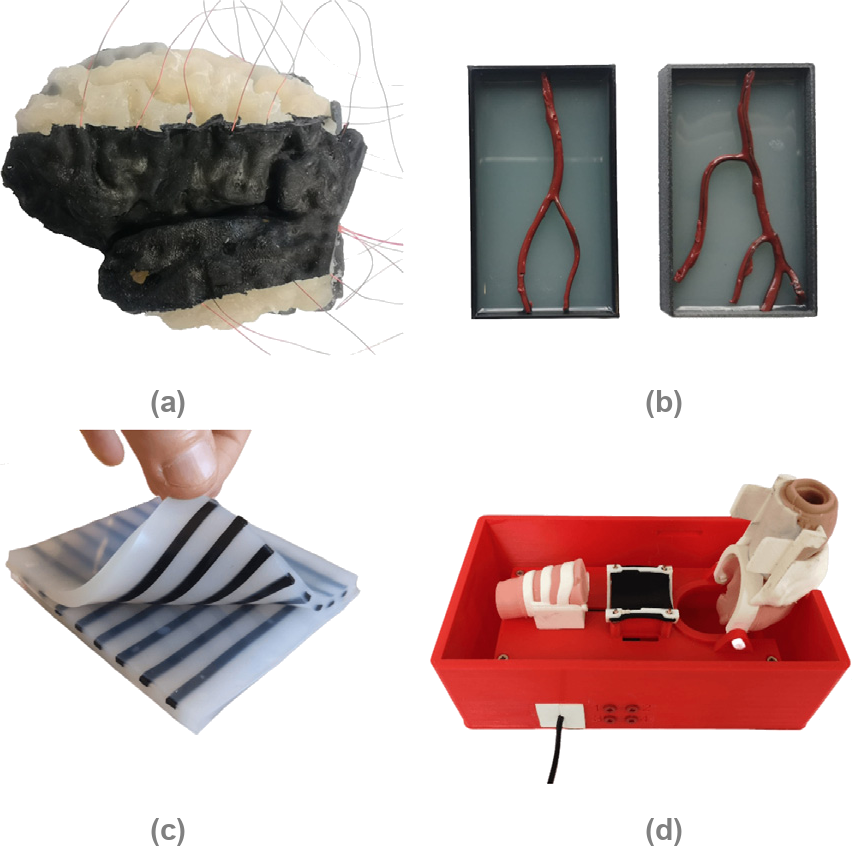
Smart Artificial Soft Tissue and smart instruments
If a voltage is applied to a conductive surgical instrument, the instrument itself becomes part of the measurement. When it touches the sensor layer, the potentials at the edges of the layer change, and the contact position is reconstructed by inverse resistance mapping. No fixed reference point is needed, which is a major advantage in highly deformable tissue where target regions must be reached or avoided. Real surgical instruments can therefore be used and tracked inside the artificial anatomy.
This Smart Artificial Soft Tissue was first applied in a hybrid simulator for training the implantation of a laryngeal pacemaker, where it detects the position of the insertion tool at the cricoid cartilage with sufficient accuracy for objective feedback [2]. More details are on the project page Smart Artificial Soft Tissue; the simulator is shown in Figure 1(d).
Open-source sensor interface
Soft sensors need suitable electronics. We developed a small, low-cost interface module that measures complex voltages and impedances between 17 channels at different frequencies. Evaluating the signals by discrete Fourier transform suppresses disturbances, and higher measuring frequencies avoid the contact problems typical of piezoresistive soft materials. The module is connected via USB and has software interfaces for Python and MATLAB.
With the same hardware, simple strain or pressure sensors, multilayer arrangements for up to three-dimensional tracking of conductive instruments, and electrical impedance tomography (EIT) of conductive structures can be evaluated. Circuits, firmware, software and CAD data are published as open source to speed up the development of new simulators [3].
Dynamic Tactile Synthetic Tissue
Passive phantoms cannot imitate the motion of living tissue. Our Dynamic Tactile Synthetic (DTS) Tissue therefore combines sensing and actuation in one fully soft unit: hydraulic chambers move the tissue surface and measure pressure and force, while an embedded carbon black silicone layer detects internal and external deformations by EIT (Figure 2). Together, this allows real-time feedback and closed-loop control [4].
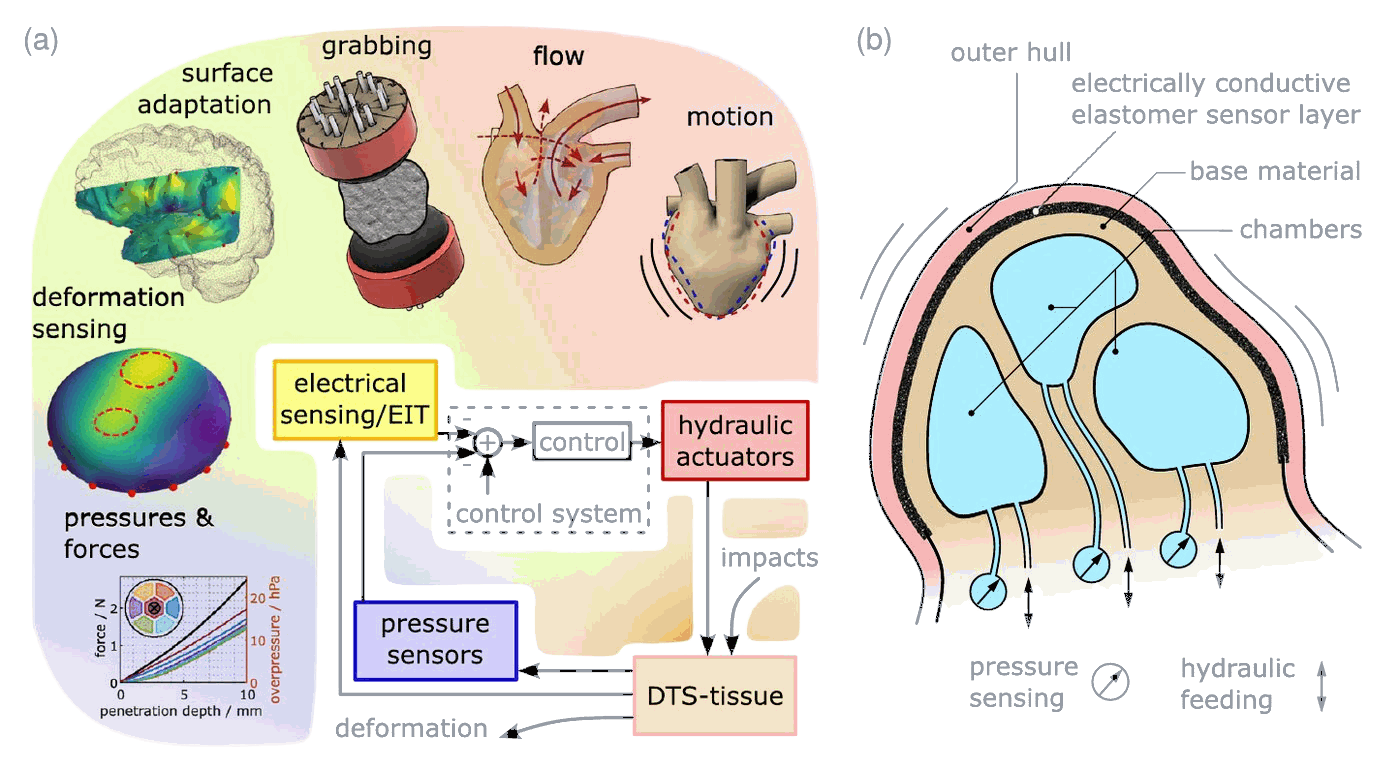
The DTS Tissue was demonstrated as a soft gripper handling objects from raspberries to heavy machine parts, and in surgical simulation as a dynamic brain phantom and a beating fetal heart. These applications are described on the project pages Dynamic Tactile Synthetic Tissue, MEDUSA and Fetal Heart Phantom.
Figure 1 from [1] (background removed), Figure 2 from [4], both licensed under CC BY 4.0.
References
- (2024): Carbon black silicone composite in surgical simulation - A detailed electromechanical characterization. In: Sensors and Actuators, A: Physical, vol. 370, pp. 115262, 2024, ISSN: 0924-4247, (Publisher Copyright: © 2024 The Authors).
- (2023): Smart Artificial Soft Tissue - Application to a Hybrid Simulator for Training of Laryngeal Pacemaker Implantation. In: IEEE Transactions on Biomedical Engineering, vol. 70, no. 2, pp. 735–746, 2023, ISSN: 0018-9294, (Publisher Copyright: © 1964-2012 IEEE.).
- (2023): Open Source Sensor Interface for Soft Detectors in Surgical Simulators. In: IEEE Access, vol. 11, pp. 49650–49664, 2023, ISSN: 2169-3536, (Publisher Copyright: © 2013 IEEE.).
- (2024): Dynamic Tactile Synthetic Tissue: from Soft Robotics to Hybrid Surgical Simulators. In: Advanced Intelligent Systems, vol. 6, no. 12, 2024, ISSN: 2640-4567, (Publisher Copyright: © 2024 The Author(s). Advanced Intelligent Systems published by Wiley-VCH GmbH.).