
Artificial Anatomy
This research area aims to develop validated artificial structures such as bones and soft tissue. They are the main components of the patient phantom and essential for imitating realistic haptic feedback.
Artificial bones
Orthopaedic interventions require cutting, drilling or penetrating bone. Artificial bones incorporated into the patient phantom should therefore imitate human bone as closely as possible in order to achieve realistic haptic feedback. Depending on the intervention, this haptic feedback is characterised, for example, by
- the needle insertion force during penetration of the vertebra in cement augmentation techniques (see Figures 1 and 2),
- the torque when inserting a screw for osteosynthesis, or
- the cutting forces when sawing, drilling or milling bone tissue during orthopaedic surgery.
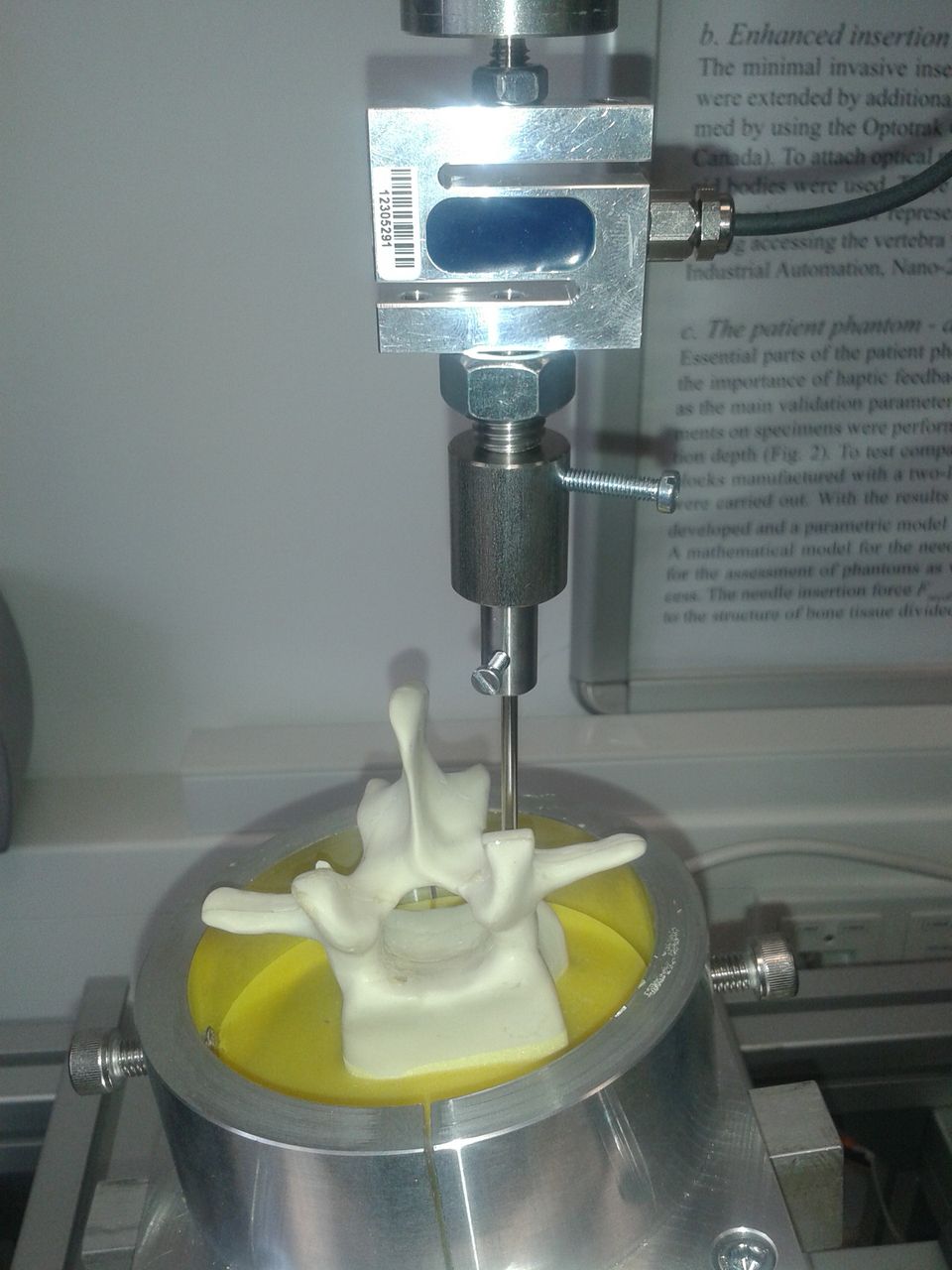
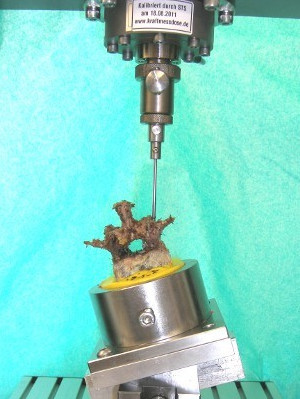
Developing artificial bone structures involves various rapid prototyping technologies, including 3D printing and moulding, with different materials for imitating cortical and trabecular bone. Since these two bone tissues differ in both mechanical properties and morphology, materials with very different processing properties have to be combined. For the artificial vertebrae used in a cement augmentation simulator, the trabecular bone is imitated by a polyurethane (PU) foam. The PU foam is cast into resin shells of different material properties and thicknesses and shows realistic needle insertion forces compared with human specimens [1], [2].
The trabecular structure was further developed into open-cell foams whose compressive and morphometric properties mirror human vertebral trabecular bone [3]. These allow balloon dilatation and bone cement injection [4] as well as realistic pedicle screw placement [5], [6]. Similar bone surrogates were developed for the skull, for drilling, milling and sawing [7] and for screw fixation of bone grafts [8].
Artificial soft tissue
Artificial muscles and connective tissue can be made of silicone, with silicone rubber as the base material. Silicone oil is added to the rubber in different proportions of the total mass to achieve more realistic viscoelastic behaviour and to provide a kind of lubrication when the needle penetrates the tissue. Layered artificial structures are created by stacking discrete silicone layers with distinct ratios of silicone rubber to silicone oil.

To validate the artificial tissue blocks, biomechanical measurements are performed on human tissue specimens and compared with the artificial samples. In cement augmentation, the needle penetrates the soft tissue, so the needle insertion force serves as the characteristic parameter. Since human soft tissue shows distinct viscoelastic behaviour, the measurements are performed in three phases (see Figure 3): insertion – relaxation – extraction.
- Insertion: the needle is inserted into the specimen to a predefined depth at a predefined feed rate.
- Relaxation: the needle is held still for a defined period of time.
- Extraction: the needle is withdrawn at a predefined feed rate.
As shown in [9], an artificial tissue block made of silicone imitates human muscle tissue with tendon and skin quite well.
Layered soft tissue structures were also developed for epidural needle insertion, reproducing the force peaks at the ligaments of human specimens [10], [11]. More recently, electrically conductive carbon black silicone composites add sensing capabilities to the artificial tissue [12], [13].
References
- (2012): Foam phantom development for artificial vertebrae used for surgical training.. In: Conf Proc IEEE Eng Med Biol Soc, vol. 2012, pp. 5773–5776, 2012.
- (2013): Artificial Vertebrae for a Novel Simulator in Minimally Invasive Spine Surgery.. In: Biomed Tech (Berl), 2013.
- (2017): Characterization of synthetic foam structures used to manufacture artificial vertebral trabecular bone. In: Materials Science and Engineering C, 2017.
- (2018): Characterization of polyurethane-based synthetic vertebrae for spinal cement augmentation training. In: Journal of Materials Science: Materials in Medicine, vol. 29, no. 10, pp. 153, 2018, ISSN: 1573-4838.
- (2018): Procedure-specific validation of artificial vertebrae. In: 2018.
- (2019): Development of open-cell polyurethane-based bone surrogates for biomechanical testing of pedicle screws. In: Journal of the Mechanical Behavior of Biomedical Materials, vol. 97, pp. 247–253, 2019, ISSN: 1751-6161, (Funding Information: The Research Group for Surgical Simulators Linz (ReSSL) acknowledges the financial support by the Austrian Research Promotion Agency (FFG) within the program line Cooperation & Innovation (COIN) and project number 845436. Publisher Copyright: © 2019 Elsevier Ltd Copyright: Copyright 2019 Elsevier B.V., All rights reserved.).
- (2017): Characterization of an Artificial Skull Cap for Cranio-Maxillofacial Surgery Training. In: JOURNAL OF MATERIALS SCIENCE-MATERIALS IN MEDICINE, vol. 29, no. 9, 2017, ISSN: 0957-4530.
- (2019): Bone surrogates provide authentic onlay graft fixation torques. In: Journal of the Mechanical Behavior of Biomedical Materials, vol. 91, pp. 159–163, 2019, ISSN: 1751-6161, (Publisher Copyright: © 2018 Elsevier Ltd Copyright: Copyright 2019 Elsevier B.V., All rights reserved.).
- (2014): Artificial muscles for a novel simulator in minimally invasive spine surgery.. In: Conf Proc IEEE Eng Med Biol Soc, pp. 506-509, 2014.
- (2016): Development of artificial tissue-like structures for a hybrid epidural anesthesia simulator. In: Proceedings of the 38th Annual International Conference of the IEEE Engineering in Medicine and Biology Society, 2016.
- (2020): Characterization of tissue properties in epidural needle insertion on human specimen and synthetic materials. In: Journal of the Mechanical Behavior of Biomedical Materials, vol. 110, 2020, ISSN: 1751-6161.
- (2023): Smart Artificial Soft Tissue - Application to a Hybrid Simulator for Training of Laryngeal Pacemaker Implantation. In: IEEE Transactions on Biomedical Engineering, vol. 70, no. 2, pp. 735–746, 2023, ISSN: 0018-9294, (Publisher Copyright: © 1964-2012 IEEE.).
- (2024): Carbon black silicone composite in surgical simulation - A detailed electromechanical characterization. In: Sensors and Actuators, A: Physical, vol. 370, pp. 115262, 2024, ISSN: 0924-4247, (Publisher Copyright: © 2024 The Authors).